
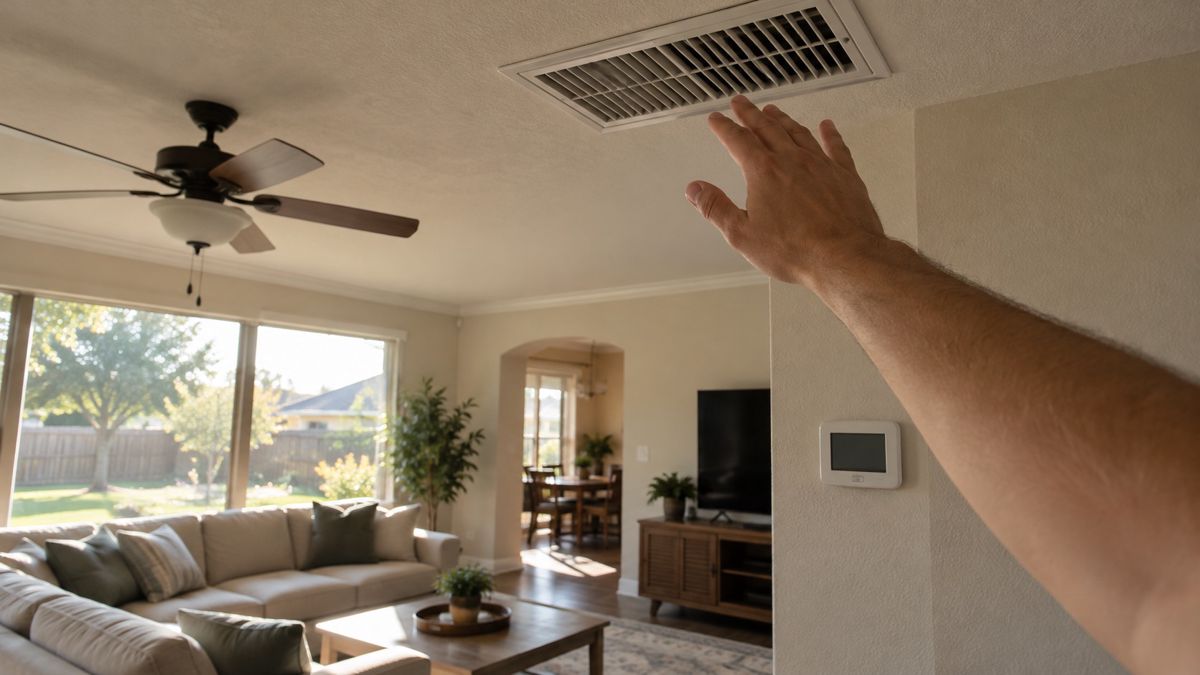
If your AC is blowing warm air on a hot Houston day, the cause is usually one of a short list: a thermostat or filter problem, a frozen coil, a dirty or failed outdoor unit, low refrigerant from a leak, or leaky ducts in a hot attic. Some of these you can check safely in a few minutes. Others need a technician. This guide walks through each, in the order that makes sense, so you do not waste a hot afternoon guessing.
What quick checks can you do safely first?
Start with the simple things. They cause more service calls than people expect.
- Thermostat. Make sure it is set to cool, the temperature is set lower than the room, and the fan is on auto. Replace the batteries if the screen is dim.
- Air filter. A clogged filter chokes airflow and can lead to a frozen coil. Replace it if it looks gray and packed.
- Breakers. Check the breaker panel for a tripped switch on the air handler or the outdoor unit. Reset it once. If it trips again, leave it off and call.
- Drain safety switch. Many attic units shut off when the drain pan fills. If water is in the pan or dripping, the drain is likely clogged.
- Vents and returns. Open the vents and keep furniture off the returns.
- Outdoor unit. Check whether the fan is spinning and the unit is running, and look for obvious debris around it.
If none of these turns up a cause, move on to the next sections. Do not keep running the system for hours in the hope that it recovers.
Could the evaporator coil be frozen?
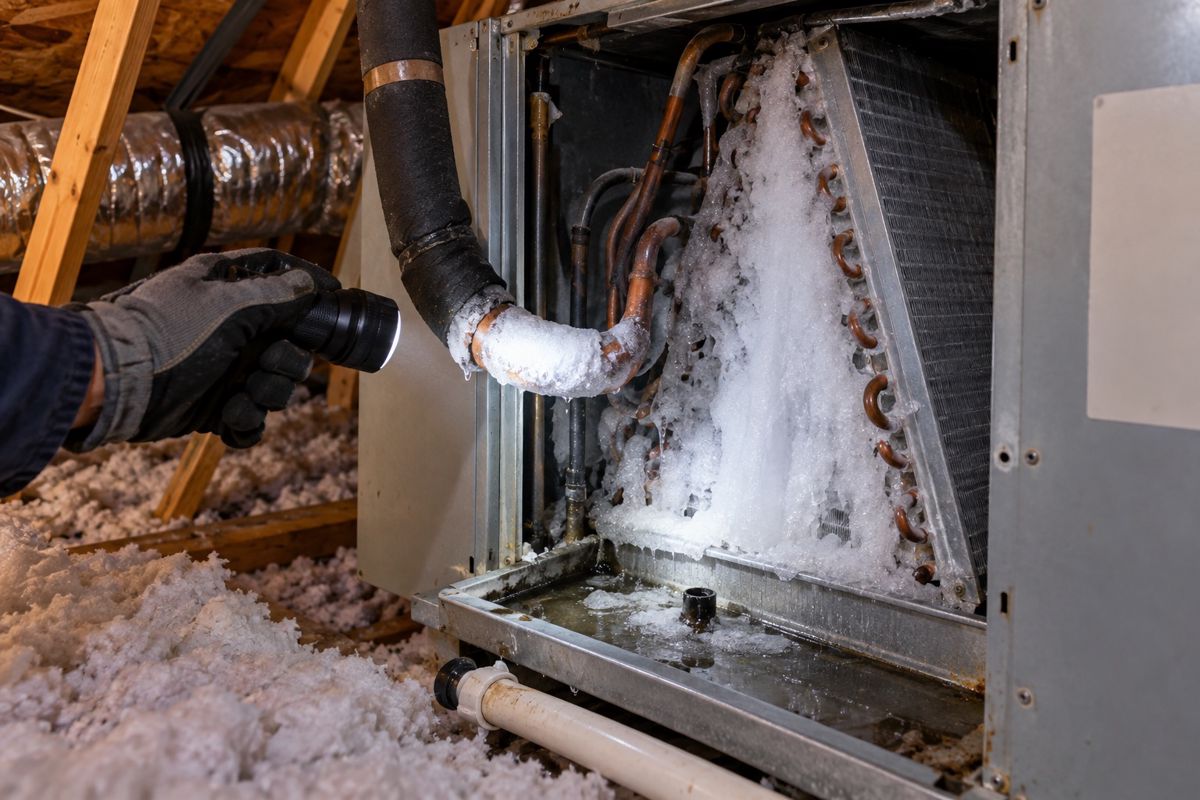
A frozen coil is one of the most common reasons for warm or weak airflow in humid weather. The coil inside the air handler is supposed to be cold, but when airflow drops or refrigerant runs low, it can drop below freezing. Moisture from Houston air then builds up as ice. You may see frost on the copper line, ice around the indoor unit, or water dripping once it starts to melt.
What to do
- Turn the thermostat to off.
- Set the fan to on so the air blowing across the coil helps it thaw. This can take a few hours.
- Replace the filter and check that the vents are open.
- Run the system again once the ice is gone.
If it freezes again, something is causing it, such as a leak, a failing blower, or restricted ducts. Repeating the cycle over and over can damage the compressor, so it needs a proper diagnosis.
Is the outdoor unit the problem?
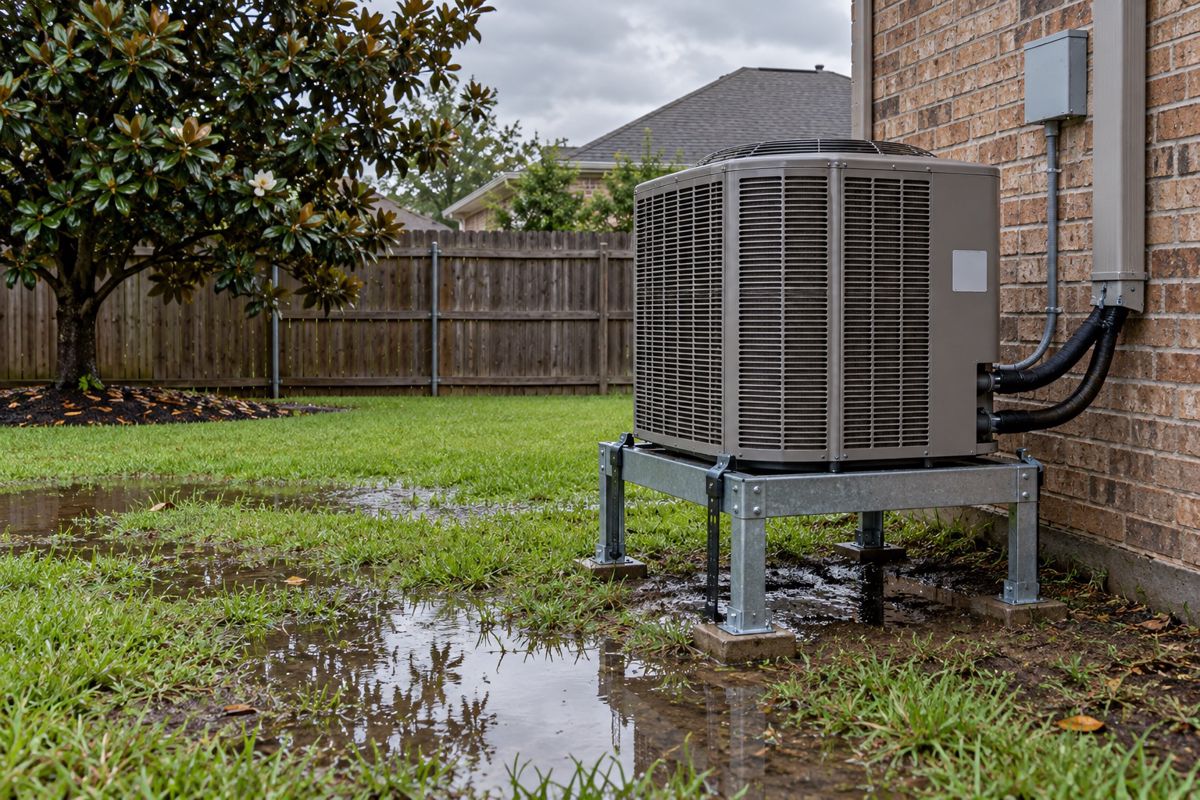
The outdoor condenser is where the heat from your house is released. If it is not working, the indoor unit may blow air that is only slightly cool. Common issues include:
- A dirty coil. Grass clippings, leaves, and dirt block airflow. Switch off power at the disconnect before any cleaning, and do not use high pressure that bends the fins.
- A failed capacitor. The unit hums but the fan or compressor does not start. This is a small, common part, but replacing it is electrical work that should be left to a technician.
- A stuck fan motor. The unit runs but the fan does not spin, which causes overheating.
- A compressor problem. This is the most serious failure and often decides whether to repair or replace.
Keep plants and fences at least a couple of feet away from the unit so air can move freely. If the outdoor unit is not running at all, turn the thermostat off and call.
Why does low refrigerant make the air warm?
Refrigerant carries heat out of your house. If the level is low, the coil does not get cold enough, and the air coming from the vents is warm or only mildly cool. You may also notice ice on the line, a hissing sound, or rising electric use.
An air conditioner does not use up refrigerant like a car uses fuel. If it is low, there is a leak. Topping it off without finding the leak is a temporary patch, and buying or handling refrigerant requires federal certification. A proper repair finds the leak, fixes it, and charges the system to the manufacturer's specification.
The type of refrigerant also matters. Older systems that use R-22 face limited supply because it has been phased out of new production, and newer systems use different refrigerants again. A technician can tell you which one your unit uses and what the options are.
Can attic ducts make cool air feel warm?
Yes, and in Houston it happens a lot. Many homes have the air handler and ducts in the attic, where summer temperatures can climb far above the outdoor temperature. If ducts leak, come apart, are crushed, or are poorly insulated, the cool air picks up heat on the way to the room. The system may seem to work, but the air from the vents does not feel cold.
A few clues point to this:
- Some rooms are much warmer than others.
- The air is cool at the unit but warm at the far vents.
- The house is humid even when the system runs a lot.
- You can see damaged or loose duct sections in the attic.
Humidity also plays a role. At high humidity, air can feel warm and clammy even when the temperature at the vent is reasonable. As a rough guide, supply air is often around fifteen to twenty degrees cooler than the air returning to the unit, but that varies. If the gap is much smaller, a technician should look at airflow and refrigerant.
Sometimes the system is simply too small for the house or has aged out. In that case, a replacement may be the long-term fix, and sizing it properly is the key.
What about storms and power outages?
Hurricane season and summer thunderstorms bring outages and surges. When power returns, the system may not restart on its own, or it may restart and run poorly because of damage. A few points are worth knowing:
- Check the breakers after an outage, and reset only once.
- Wait several minutes before restarting the system so the compressor is not under strain.
- Check that the thermostat did not reset to a different mode.
- Look at the outdoor unit for debris, water, or shifted equipment.
If your street has flooded, ask about raising the outdoor unit on a stand above the expected water level and anchoring it. Check your local floodplain rules and ask about surge protection. After a flood, do not run a system that has been in water. Have it inspected first.
When should you call a technician?
Call if the unit will not start, if ice returns, if water is leaking, if breakers keep tripping, if you smell burning, or if the air is still warm after the simple checks. These are signs of a fault that gets worse the longer the system runs. A technician can read pressures, test electrical parts, check airflow, and tell you what is failing.
For problems with cooling that has stopped working, see our page on AC repair in Houston. If the repair history is long and the unit is old, read about AC replacement. For a general overview of what we do, visit our home page.