
Skip to content

Same-day serviceFinancing available

Houston, TX (713) 555-0183
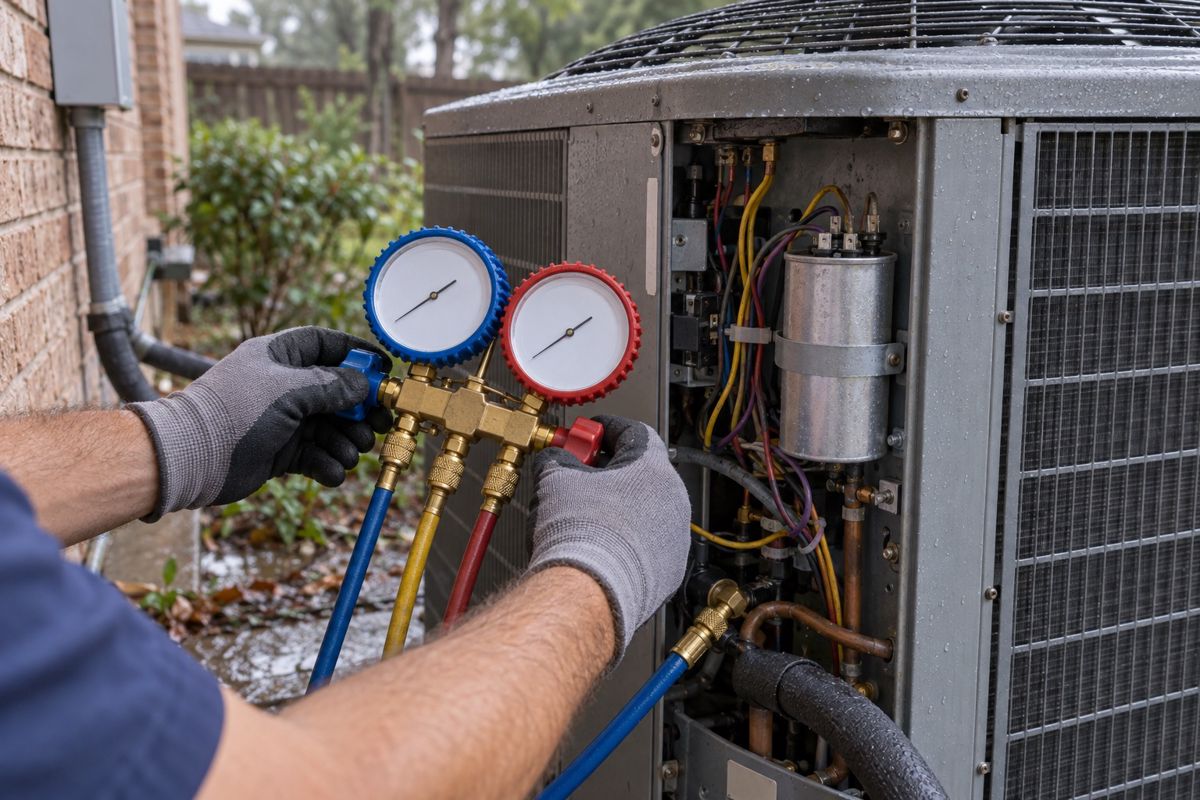
Technician's hands testing an outdoor AC unit with gauges and open panel

AC repair in Houston, TX

AC repair in Houston when the house stops cooling

Warm air, a unit that will not start, or water near the air handler. We find the cause first and explain it before any repair begins.

  • Cause found before parts are replaced
  • Written quote before work begins
  • Repairs explained in plain words

Step 1 of 3

What do you need?

What does AC repair in Houston involve?

When people search for AC repair Houston summers are usually the reason. A system that quits in August heat leaves a house warm and sticky within hours, and the moisture hangs around long after the temperature drops. Repair work starts with finding the real fault, not swapping the cheapest part and hoping.

A typical visit covers the thermostat, the filter, the indoor air handler and coil, the condensate drain, the outdoor condenser, the electrical parts, the refrigerant circuit, and the airflow through the ducts. Most Houston homes have the air handler and ducts in a hot attic, so a technician often works in tight, heated space. That is why a proper diagnosis takes more than a glance at the outdoor unit.

Once the fault is found, you get the options in plain language: what failed, why it likely failed, what the repair is, and what else is worth watching.

Which problems break Houston air conditioners most often?

Our climate puts the same few parts under stress year after year.

  • Failed capacitors and contactors. These small electrical parts start and run the fan and compressor. Heat and long run times wear them out, and the outdoor unit may hum without starting.
  • Clogged condensate drains. Humid air means a lot of water pulled out of your house. When the drain clogs, the pan fills and a safety switch may shut the system off, or water reaches the ceiling.
  • Frozen evaporator coils. Poor airflow or low refrigerant can ice the coil. You see frost on the lines and weak airflow.
  • Refrigerant leaks. Refrigerant is not used up like fuel. If the level is low, there is a leak that has to be found.
  • Dirty outdoor coils. Grass clippings, leaves, and dirt choke airflow around the condenser.
  • Storm damage. Power surges, lightning, and flooding can harm the compressor, control board, or motors.

What changes the price of an AC repair?

We do not post prices because the same symptom can come from very different faults. These things move the final number:

  • Which part failed, and whether it is common or specialized for your brand and age of unit.
  • Whether the refrigerant circuit leaks. Refrigerant type matters, because older R-22 systems use a refrigerant that has been phased out of new production.
  • How hard the equipment is to reach. Attic air handlers, tight closets, and roof-mounted units change the work involved.
  • Whether the failure caused a second problem, such as water damage or a burned-out motor.
  • The age and condition of the whole system.

We weigh the repair against the value of the unit. When repairs keep piling up, we will say so and explain whether central AC replacement makes more sense.

Many repairs are finished in one visit when the part is on the truck, but we cannot promise that in advance. Some faults need a part ordered, and some need a second visit to confirm the fix under real load. We tell you which applies as soon as we know.

What to expect

  1. The technician asks what you noticed: when it stopped, any noises, any water, any breaker trips.
  2. They check the thermostat, filter, drain, indoor unit, outdoor unit, and electrical parts, and take readings.
  3. You get the cause, the options, and a written quote.
  4. After you approve, the repair is done and the system is run to confirm temperatures and airflow.
  5. You get a short walkthrough of what was done and what to watch.

It helps if the attic access is clear and someone can show the technician where the air handler and breaker panel are.

When should you call, and when is it time to think about replacement?

Call when you notice warm air, a unit that will not start, ice on the lines, water near the indoor unit, a burning smell, or loud banging. Running a system with these symptoms can turn a small fault into a compressor failure. If you see ice, turn the thermostat to off and set the fan to on so the coil can thaw. If water is dripping from the ceiling, turn the system off at the thermostat and the breaker.

Repair makes sense when the unit is fairly young and the fault is contained. Replacement deserves a hard look when the system is very old, the compressor has failed, or the leak keeps coming back. If the problem is a humid, clammy house, read about indoor air quality and humidity control. For the full list of services, see our home page, or call (713) 555-0183.

  • Same-day service
  • Financing available
  • Clear communication
  • Upfront pricing

How it works

  1. Book a visit

    Call or request a time online.

  2. Diagnosis and quote

    A technician finds the problem and quotes the fix.

  3. Repaired or replaced

    Most repairs finished the same day.

Request emergency ac repair

Tell us what you need and we call you back.

No obligation.

Step 1 of 3

What do you need?

Questions about hvac in Houston

Why is my AC running but not cooling in Houston?

Common causes are a dirty filter, a frozen coil, a dirty outdoor unit, a failed capacitor, low refrigerant from a leak, or leaking ducts in the attic. Check that the thermostat is set to cool and the filter is clean. If the air is still warm, turn the system off and call. Running it longer can damage the compressor.

Is it safe to keep running an AC that is freezing up?

No. Ice on the coil blocks airflow and can send liquid refrigerant back to the compressor, which is an expensive part. Switch the thermostat to off, leave the fan on so the ice melts, and wait. If it freezes again after thawing, something is causing it, such as low airflow or a leak, and it needs a proper diagnosis.

Why is water leaking from my indoor unit or ceiling?

The most common cause is a clogged condensate drain line. Houston air holds a lot of moisture, so the unit makes plenty of water. When the drain backs up, the pan overflows. Turn the system off at the thermostat and breaker, and call. A secondary pan and float switch can help prevent water damage.

Can I just add refrigerant when it is low?

Low refrigerant means a leak, so adding more is only a temporary patch. Handling refrigerant also requires federal certification. A proper repair finds and fixes the leak, then charges the system to the manufacturer's specification. Otherwise you pay for refrigerant again and risk running the system without enough cooling.

How can I check that an AC contractor is licensed in Texas?

Texas air conditioning and refrigeration contractors are licensed by TDLR. Ask for the contractor's license details and look them up on the TDLR website before work starts. Also ask for proof of insurance and a written quote. A contractor who avoids those requests is a warning sign. This is general advice to help you compare any contractor.

Can a storm or power outage damage my air conditioner?

Yes. Surges when power returns, lightning, and flooding can damage the compressor, control board, and motors. After an outage, consider waiting several minutes before restarting so the system is not stressed. Ask about surge protection, and if your area floods, ask about raising the outdoor unit on a stand.

Ready when you are

Call now or request a quote online.

(713) 555-0183
Get a free estimate